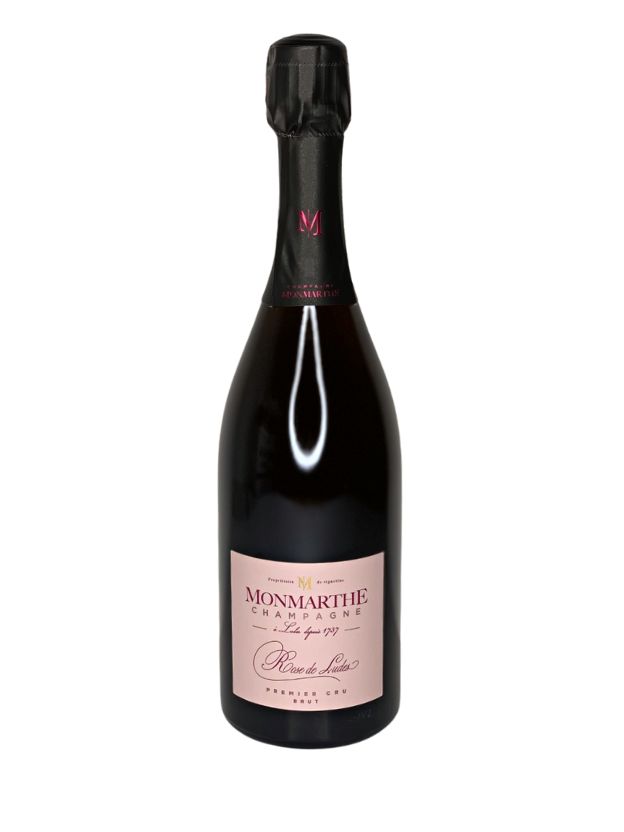
MONMARTHE ROSE DE LUDES BRUT
Share
USD$75.00
In stock: 120 available
Product details
CHAMPAGNE MONMARTHE “ROSÉ DE LUDES” BRUT PREMIER CRU
Style Summary
A vibrant and gastronomic Premier Cru Rosé Champagne from Ludes in the Montagne de Reims, combining fresh red fruit with attractive vinosity, fine bubbles and mineral freshness.
Rosé de Ludes is produced using the traditional rosé d’assemblage method, blending Champagne base wines with still red Coteaux Champenois Pinot Noir.
Wild strawberry, raspberry, redcurrant and blackcurrant dominate the aromatic profile, complemented by citrus, subtle floral notes and gentle spice.
Four years of lees ageing adds texture and complexity while retaining the wine's fresh, fruit-driven personality.
A beautifully versatile rosé Champagne with enough structure to move effortlessly from aperitif through an entire meal.
Region / Grape / Style
Region: Champagne, France
Subregion: Montagne de Reims
Village: Ludes – Premier Cru
Producer: Champagne Monmarthe
Cuvée: Rosé de Ludes
Classification: Premier Cru
Style: Brut Rosé Non-Vintage
Pinot Noir: 40%
Meunier: 30%
Chardonnay: 20%
Coteaux Champenois Red Wine: 10% Pinot Noir
Blend: Three Successive Harvests
Vinification: Temperature-Controlled Stainless Steel
Malolactic Fermentation: Yes
Lees Ageing: Minimum 4 Years
Dosage: 8 g/L
Post-Disgorgement Rest: 3–6 Months
The Rosé de Ludes Blend
Rosé de Ludes is produced as a classic rosé d’assemblage.
Rather than obtaining its colour through prolonged skin contact, Monmarthe blends its white Champagne base wines with approximately 10% still red Coteaux Champenois.
Importantly, that red wine is Pinot Noir produced from some of the family's older vineyard parcels.
The blend is:
40% Pinot Noir
Structure · Red Fruit · Vinosity
30% Meunier
Roundness · Fruit · Approachability
20% Chardonnay
Freshness · Citrus · Precision
10% Red Coteaux Champenois Pinot Noir
Colour · Strawberry · Blackcurrant · Additional Structure
The result is a rosé Champagne that emphasizes genuine red-fruit character rather than simply colour.
Vinification & Ageing
The base wines are vinified in temperature-controlled stainless-steel tanks, preserving fruit purity and freshness.
Malolactic fermentation is completed, contributing a softer, more rounded texture.
As a non-vintage Champagne, Rosé de Ludes combines wines from three successive harvests, helping maintain the house style while adding complexity.
The Champagne then spends a minimum of approximately four years ageing on its lees in Monmarthe's cellars.
This is substantial maturation for a non-vintage rosé and contributes additional texture and complexity to the wine.
Dosage is approximately 8 g/L, keeping it comfortably within the Brut category while balancing the natural acidity and red-fruit character.
After disgorgement, the Champagne rests for approximately three to six months before release.
Tasting Profile
Appearance:
Elegant salmon-pink with fine, persistent bubbles.
Nose:
Wild strawberry and raspberry lead initially, followed by redcurrant and blackcurrant.
With air, subtle citrus, floral and gentle spice notes emerge.
Palate:
Lively and fresh on entry, developing greater breadth through the middle of the palate.
Strawberry, raspberry and blackcurrant provide attractive fruit concentration, while fresh acidity and fine bubbles maintain energy.
Structure:
Medium-bodied for Champagne, combining freshness with sufficient Pinot Noir-driven vinosity to work throughout a meal.
The addition of still red Pinot Noir provides greater depth and structure than would be expected from a particularly delicate rosé.
Finish:
Fresh and persistent, with lingering red berries, blackcurrant, citrus and subtle mineral notes.
Summary
Rosé de Ludes is one of the most gastronomically versatile Champagnes in the Monmarthe range.
Its character comes from the combination of Pinot Noir, Meunier and Chardonnay with 10% still red Coteaux Champenois Pinot Noir.
This creates considerably more than simply an attractive salmon colour.
The red wine contributes genuine strawberry, raspberry and blackcurrant character together with additional structure.
Pinot Noir provides vinosity, Meunier adds roundness and fruit, while Chardonnay maintains freshness.
A minimum of four years on the lees adds further texture and complexity.
The result is a rosé Champagne that successfully balances:
Red Fruit · Freshness · Vinosity · Fine Bubbles · Mineral Precision
It is sufficiently refreshing for an aperitif but has enough body and structure to accompany an entire meal.
Drinking Window
Drink: Now–2031
Preferred Window: Now–2029
Rosé de Ludes is released ready to drink.
There is no need to cellar it before opening.
Today, the wine should emphasize:
Wild Strawberry · Raspberry · Redcurrant · Blackcurrant · Citrus
The four years of lees ageing have already provided sufficient development to give the Champagne texture and integration.
Another two to four years of careful cellaring should bring slightly more developed notes of:
Dried Strawberry · Blood Orange · Brioche · Pastry · Toasted Almond · Gentle Spice
However, I would enjoy this primarily for its balance of fresh red fruit and developed Champagne complexity rather than hold it for extended ageing.
Serving Temperature: 9–11°C
For an aperitif, serve around 9–10°C.
With food, allow it to reach approximately 11°C.
A tulip-shaped Champagne glass or smaller Burgundy glass will show the red-fruit character considerably better than a narrow flute.
Food Pairing
This is where Rosé de Ludes becomes particularly interesting.
Its red-fruit character and Pinot Noir structure allow it to accompany dishes that would overwhelm a very delicate Blanc de Blancs.
Recommended Pairings:
Imperial Gold Osetra Caviar · Tuna Tartare · Tuna Sashimi · Salmon · Crab · Lobster · King Crab · Grilled Prawns · Scallops · Duck Breast · Roast Duck · Quail · Charcuterie · Prosciutto · Comté · Wild Strawberry Tart · Raspberry Tart · Dark Chocolate
The producer specifically recommends crab and lobster, as well as chocolate and wild-strawberry desserts.
The Tasting Room Recommendation
I would particularly recommend Rosé de Ludes with lobster, tuna or duck.
The Champagne has enough Pinot Noir character and red-fruit concentration to stand alongside richer ingredients, while its acidity and bubbles keep the pairing fresh.
For a seafood pairing, choose lobster or king crab.
For something more adventurous, serve it with duck breast and a restrained red-fruit jus.
And unlike many Champagnes, Rosé de Ludes can transition successfully into dessert.
A wild strawberry tart with restrained sweetness would make an excellent final pairing.
Rosé de Ludes vs. Secret de Famille
These two Champagnes provide very different expressions of the Monmarthe house style.
Secret de Famille Brut
White Peach · Mirabelle Plum · Orchard Fruit · Honey · Rounded · Classic
Rosé de Ludes Brut Rosé
Wild Strawberry · Raspberry · Blackcurrant · Fresh · Vinous · Gastronomic
Secret de Famille is the more traditional all-purpose Brut and an excellent aperitif Champagne.
Rosé de Ludes has greater red-fruit character and vinosity, making it the more gastronomic choice.
For The Tasting Room, I would position Rosé de Ludes not simply as a “pink Champagne,” but as a food-driven Premier Cru Rosé capable of accompanying an entire meal.
MONMARTHE ROSE DE LUDES BRUT
Share
Display prices in:KYD